Left-hand or right-hand corner sofa: how to choose the right orientation
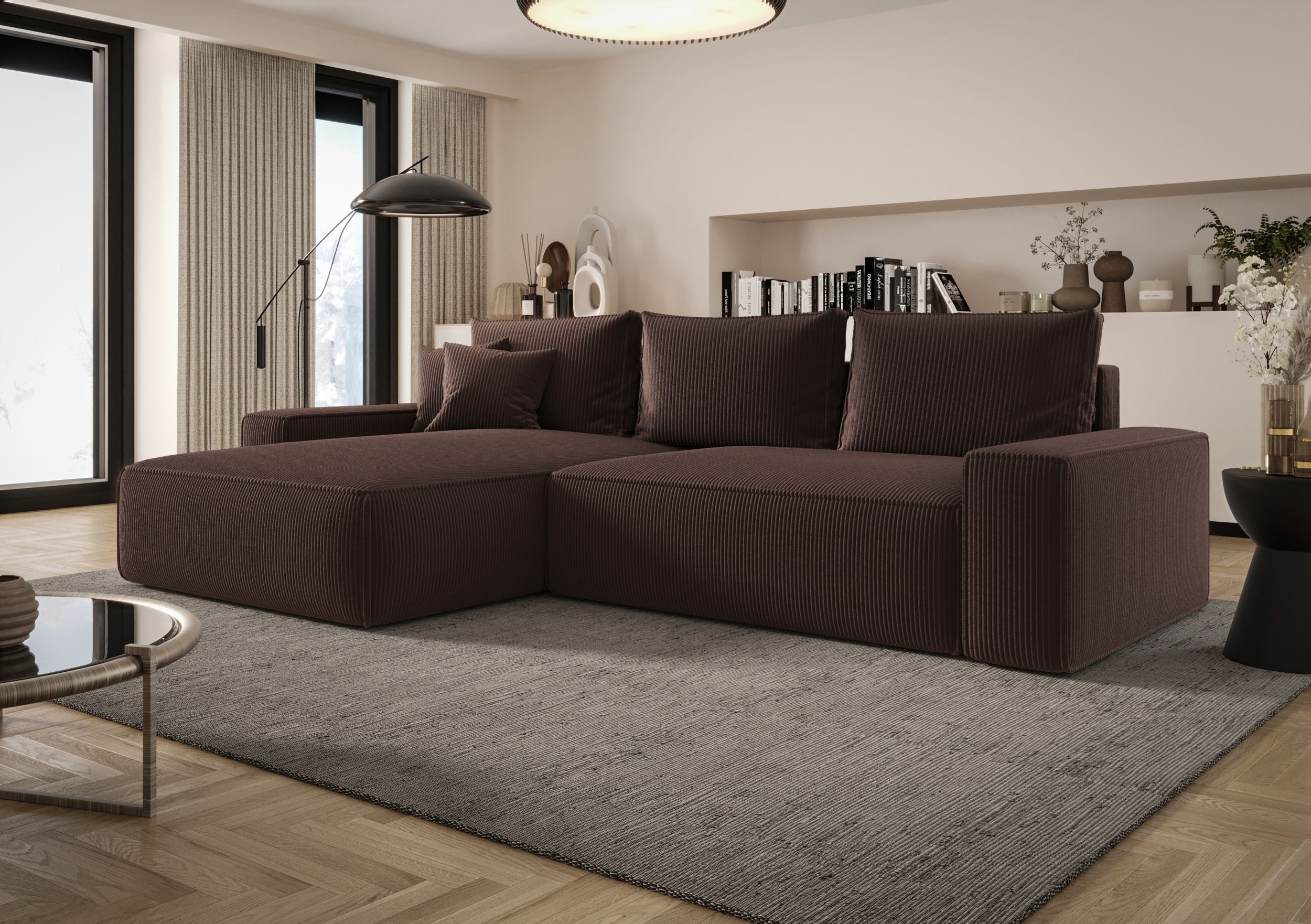
Left-hand or right-hand corner sofa? Decide on the orientation using a plan of your living room before choosing the upholstery colour. The position of the chaise affects how you reach the window, open the balcony door and sit around the coffee table. Two sofas with identical dimensions can work very differently when their extended sections are on opposite sides. Plan around the routes your household uses every day.
Identify the side while facing the sofa
Stand in front of the sofa, looking towards its main seating area as you would in a front-facing product photograph. If the chaise, the extended section for stretching out your legs, is on your left, the sofa is left-hand facing. If it is on your right, it is right-hand facing. Do not identify the side while sitting on the sofa: the directions are reversed, which can lead to ordering the wrong version.
Always check the selected option and the model's diagram before ordering. Compare with a clear front view. When browsing living room corner sofas, compare the chaise position with your room plan rather than simply copying the wall arrangement in the styled photograph.
Follow the routes through your room
Mark the entrance, balcony doors, windows and television position on a simple sketch. Then draw the routes between the entrance and the other areas. The chaise should not force you to walk around the entire sofa whenever you go to the kitchen or balcony. Allow for opening doors and reaching radiators, curtains and sockets that you regularly use.
In an open-plan living and dining space, an extended section can define a gentle boundary between the two areas. Make sure it does not occupy the space needed to pull out dining chairs. With L-shaped corner sofas, placing the longest section against the longest wall is not always the most practical arrangement. Sometimes the room works better with the chaise facing inwards and the straight seating section closer to the window.
Test both orientations in a small living room
Use removable floor tape to mark the sofa's overall width and depth, followed by the outline of the chaise. Test both orientations rather than deciding from a photograph alone. Walk through the proposed route carrying a shopping bag and try opening nearby cupboards. This reveals problems around alcoves, angled entrances and balcony doors.
Include the coffee table in your test. Leave room to get out of the middle seat without squeezing past the table. If the layout is too tight, compare sofas with narrower arms or a smaller overall depth. Use actual measurements: a name such as “mini” does not establish whether a sofa fits.
Check the layout with the sleeping function open
Choosing the side also means considering how the room works in the evening. Find out which section slides or folds out and in which direction it moves. The sleeping area dimensions describe the surface used for lying down, not the complete footprint of the unfolded sofa. Use the drawing and instructions to check opening clearance and access.
Mark the unfolded position on the plan and decide where the coffee table will go overnight. Make sure doors can still open and the bedding compartment remains accessible. A layout that looks attractive with the sofa closed may become inconvenient if you have to move several other pieces of furniture to prepare the bed.
When is a reversible model useful?
If you expect to move home or rearrange the living room, explore universal L-shaped corner sofas. Their orientation can be set according to the construction and assembly method provided for that model. This does not mean every corner sofa can be reversed, or that changing sides involves only moving cushions. Read the assembly instructions and check when and how the orientation can be changed.
A reversible sofa still needs enough room in each configuration. If moving the chaise to the opposite side blocks the exit, the ability to reassemble the sofa does not solve the layout problem. Check both the construction and the available floor space. A fixed version can work just as well in a settled layout.
Confirm the selected option before ordering
Write down your decision in plain language: “chaise on the left when viewed from the front” or “chaise on the right when viewed from the front”. Compare that note with the product photograph, orientation selector and dimension drawing. Ask the shop to confirm the configuration if any of them appear inconsistent. Check carefully when the gallery shows both versions.
Start your choice with comfortable circulation around the room, then compare the opening mechanism, seat dimensions and upholstery. Explore Cornero to coordinate the rest of your furniture. The orientation should work when guests visit and the sleeping function is open, as well as when the sofa is closed.